Statamic vs Drupal: why most websites do not need the heavy machinery
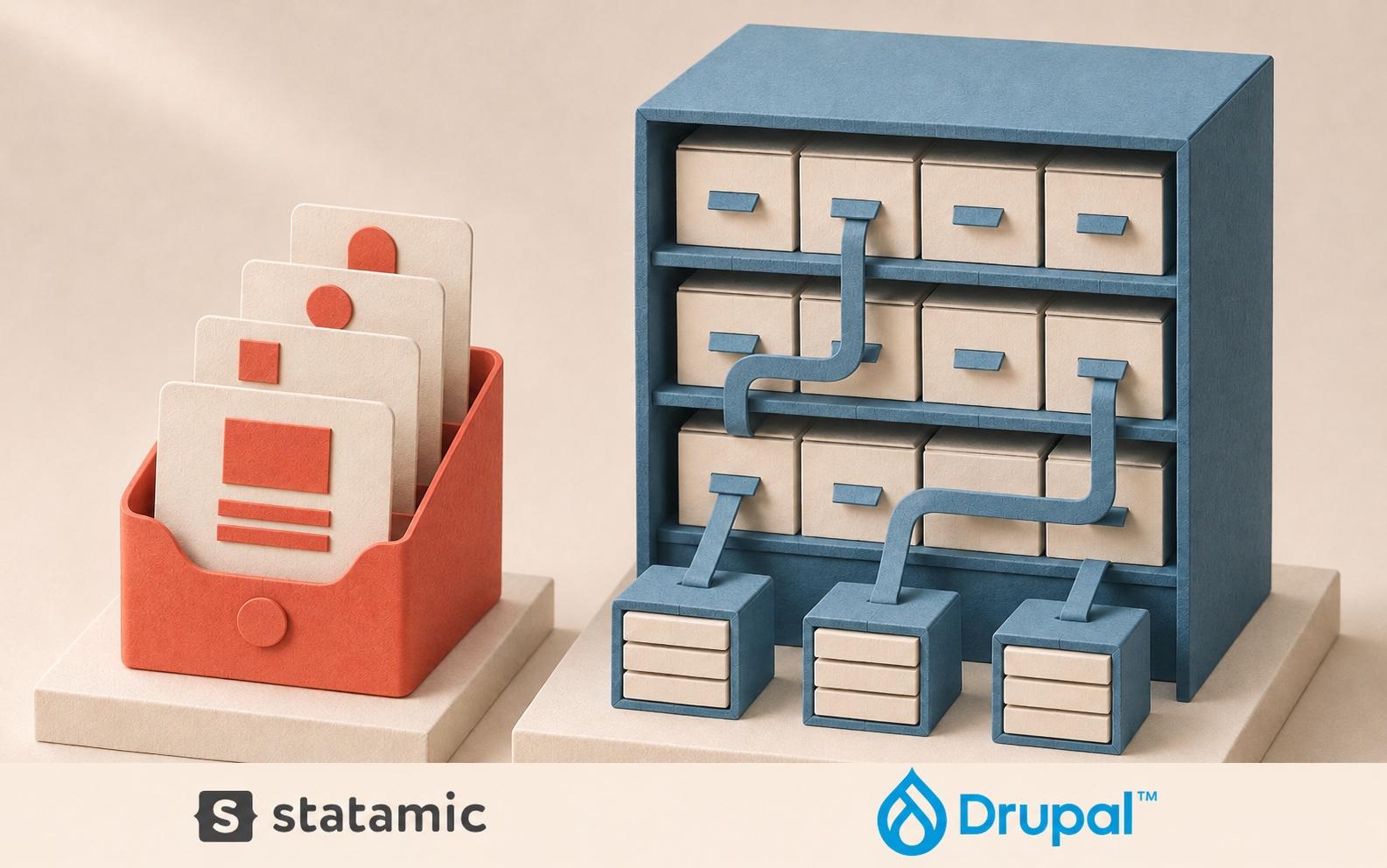
For most websites Statamic is the better choice. It does what a content site needs with less code, simpler hosting and far less upkeep, and editors learn it in an afternoon. Drupal is built for a different size of problem: hundreds of editors, strict permissions, formal approval chains and many integrations. If that does not describe your organisation, you are paying for machinery you will never use.
At CNJ we build content websites on Statamic, usually in headless mode: Statamic holds the content and a separate front end displays it. We also talk to organisations that run Drupal and wonder whether to upgrade or leave. This article explains why we so often recommend leaving, and when we do not.
Where Drupal stands today
Drupal is actively developed. The dates below come from the official Drupal release schedule, checked in November 2026.
Drupal 7: end of life on 5 January 2025.
Drupal 10: end of life on 9 December 2026.
Drupal 11: the current version, supported until early December 2028.
Drupal 12: planned for the week of 7 December 2026.
That list shows the first cost of Drupal. A new major version arrives about every two years and the old one loses support soon after. Every site owner is on a schedule set by someone else.
Many owners do not keep up. According to W3Techs data reported by The Drop Times in August 2026, about half of the Drupal sites it detects run a version that no longer gets security fixes. Many of those are Drupal 7 sites, and Drupal 7 does not upgrade to a modern version; it gets rebuilt.
In January 2026 the project released Drupal CMS 2.0, a ready-made distribution with a visual page builder called Canvas. It is Drupal's answer to the complaint that a fresh install gives you very little to work with. It makes starting easier. It does not make the system underneath any smaller.
Where Statamic is ahead
Less system to build and maintain. Drupal is a framework for building content platforms, and almost everything in it has to be configured before it is useful. Statamic covers what a content website needs and is ready to use after installation. The same site takes less time to build and much less time to keep running.
Total cost. Drupal is free and Statamic Pro costs $349 per site with one year of updates, then $99 a year. On a real project the licence is a rounding error. Development and maintenance decide the total, and a Drupal build takes more of both.
Content in files. Drupal stores everything in a database. Statamic stores content in files by default, so every change can be tracked in Git, backups are simple, and a test copy of the site needs no database export. A database is still available for large volumes of content.
Editing. Statamic's control panel shows editors only what they need: defined fields, block-based editing, a preview before publishing. A short introduction is usually enough. Drupal's editing experience depends heavily on how the site was built, and is often the part editors complain about.
Developers. Drupal needs developers who know Drupal, and they are specialists. Statamic is built on Laravel, one of the most widely used PHP frameworks, so many more people can maintain it and changing contractors is not a risk.
Upgrades. Statamic upgrades are small, because there is less system to upgrade. Drupal major versions retire old code, so each one is planned work with a budget.
Hosting. A Statamic site runs on modest PHP hosting. Drupal needs a database, caching and more server to perform well.
Where Drupal is ahead
It would be dishonest to pretend Drupal has no strengths. It has two that matter.
Permissions and workflows. Fine-grained permissions, editorial states and approval chains are part of Drupal core. Statamic Pro has roles, permissions, drafts and revisions. That is enough for a marketing team, but not for an organisation where twenty departments publish under different rules.
Very complex content. When many content types reference each other and you need elaborate listings and filters across them, Drupal's data model is hard to beat.
On languages the two are level. Drupal has translation in core and Statamic Pro runs each language as a linked site.
Headless: Statamic does it with less
A headless setup means the CMS only manages content and a separate website or app reads it through an API. Most of our Statamic projects work this way, including cnj.si.
Both systems can do it. Drupal has a JSON:API module in core. Statamic Pro includes a REST API and GraphQL. The API is not what separates them. What separates them is everything behind it. In a headless setup the CMS has one job, which is to store content and hand it over. For that job Statamic is the right size, and Drupal brings along a theme layer, a rendering system and hundreds of settings you no longer need but still have to host and update.
When Statamic is the better fit
The site is mostly content: pages, news, case studies, forms, a few languages.
A small team edits it and wants to publish without calling a developer.
You want a modern, fast front end and treat the CMS as a content source.
You want simple hosting and predictable maintenance.
You are on Drupal 7 or 10 and facing an upgrade or a rebuild anyway. If the site is mostly content, doing that work in Drupal is the expensive option.
This describes most company and organisation websites we see.
When Drupal still makes sense
Many editors in different roles, with content that must pass formal approval.
Deep integration with other systems: identity management, document systems, registries.
A site on Drupal 11 that works and has a team behind it. A working system is not worth replacing for its own sake.
Moving from Drupal to Statamic
The process is the same as for any CMS migration: make an inventory, decide what not to move, set up the content model, export and import, rebuild the front end, redirect every old address. We described it step by step in our article on moving from Silverstripe to Statamic, and nearly all of it applies to Drupal too.
Two things are specific to Drupal. Content is often spread across many small pieces, such as paragraphs and referenced entities, that have to be joined back together on export. And custom modules do not move at all. Whatever they did has to be rebuilt or dropped, so their number is the main driver of cost.
The usual result is a site that does the same job with a fraction of the code.
How to start
Send us the address of the site and tell us which Drupal version it runs. We look at the content, the modules and the integrations, and tell you what a move to Statamic would involve and what it would save. If the honest answer is to stay on Drupal, we say so. Get in touch or see the Build & Launch package.
Frequently asked questions
Is Statamic a replacement for Drupal?
For most websites, yes. Content sites with a small editorial team get the same result with less cost and less maintenance. Large platforms with complex permissions, workflows and integrations are the exception.
Is Drupal free and Statamic paid?
Drupal is free. Statamic has a free Core edition with one admin account and a Pro edition at $349 per site. Over the life of a project the licence matters far less than development and maintenance, and that is where Statamic is cheaper.
What should we do with a Drupal 7 site?
Drupal 7 has had no security fixes since January 2025. It cannot be upgraded in place, so the choice is between rebuilding in a current Drupal version and rebuilding in another system. For content sites, rebuilding in Statamic is usually cheaper and leaves you with less to maintain.
Can Statamic work as a headless CMS as well as Drupal?
Yes. Statamic Pro includes a REST API and GraphQL, and most of our Statamic sites run this way. Drupal offers the same through JSON:API, with a much larger system to host and update behind it.
Is search ranking preserved when moving from Drupal?
Yes, if every old address is redirected to its new one and page titles and descriptions are kept. A short fluctuation after launch is normal.
Which is easier for editors?
Statamic. Its control panel shows editors only what they need, and a short introduction is usually enough. Drupal has improved with Drupal CMS and Canvas, but the experience still depends on how each site was built.
We write about it. We also build it.
Let's talk about your project
A 30-minute call to understand what you're building and how cvan we help. No brief required.
Prefer email?
info@cnj.si