CX in a digital context: what it is and why it matters to companies

Every new digital solution in a company leaves its leaders asking whether it really gives users a better experience. This is where CX comes in: customer experience in the digital environment, which covers every interaction a user has with your company through websites, mobile apps or social networks. Tracking key indicators such as customer satisfaction, Net Promoter Score and conversion rates lets you measure precisely how well your digital strategies work, and guides decisions on investing in advanced AI solutions.
Table of contents
What CX means in the digital environment
The basic building blocks of CX in the digital world
The role of artificial intelligence in developing digital CX
Examples of successful digital CX strategies
The most common mistakes in digital CX transformation
Key takeaways
Point | Details |
|---|---|
The importance of CX | Customer experience (CX) covers the whole customer journey and includes many interactions that are crucial for loyalty. |
Measuring success | Indicators such as Net Promoter Score and customer satisfaction are essential for tracking performance and improving CX. |
The role of artificial intelligence | Artificial intelligence optimises CX through automation and personalisation, which helps improve the user experience. |
Continuous adaptation | Digital transformation is an ongoing process. To succeed, it needs constant adjustment and the involvement of employees. |
What CX means in the digital environment
CX (customer experience) is the whole journey a customer takes with your company in the digital world. It is more than a series of individual steps: it is every interaction, touchpoint and feeling a user has with your website, mobile app, email or social network.
Put simply: CX is the overall impression a customer has of your company before they decide to buy and for a long time afterwards.
What does CX include?
CX is more than technology or interface design. It covers:
Online experience: how fast pages load, how easy it is to find information
User interface: how intuitive and attractive the design is
Communication: how quickly you reply to messages and questions
The emotional level: how “good” the customer feels when using your services
Reliability: whether your system works when the customer needs it
Each of these components affects whether a customer comes back or recommends you to others.
How is CX measured?
You can't improve what you don't measure. That is why leaders in mid-sized and large companies track performance with specific indicators:
Net Promoter Score (NPS): you ask customers how likely they are to recommend you
Customer satisfaction: measured on a scale of 1 to 10
Retention rate: how many customers come back and stay loyal
Conversion rates: how many visitors become buyers
These metrics measure the effectiveness of digital strategies in practice, not just in theory.
For easier comparison, here are the main metrics for measuring CX and what they mean:
CX metric | What it measures | Why it matters |
|---|---|---|
Net Promoter Score (NPS) | Willingness to recommend | Reveals loyalty and reputation |
Customer satisfaction | Overall feeling about the experience | Shows how well services perform |
Retention rate | Share of returning users | Measures long-term success |
Conversion rate | Turning visitors into buyers | Assesses how effective the journey is |
Customers today don't think, “This is an online experience.” They think, “This is my experience with this company.”
Why does this matter to you in particular?
As a head of digitalisation in a mid-sized or large company, you work with complex infrastructure. You have more processes, more teams and often legacy systems that need to be brought together.
In that setting, CX becomes the thread that ties everything together. When IT and marketing have slightly different ideas of what a “good experience” is, customers feel it.
CX is also the yardstick for the investments you make. If you invest in a new app or a digital project, CX metrics tell you whether that investment really delivered results or is just nice technology.
A tip from an experienced practitioner Start by measuring where you stand: what your customers really think of you now, before you invest in changes. That gives you a realistic baseline and shows the gap between words and actions.
The basic building blocks of CX in the digital world
CX is more than one thing. It is made up of several key elements that have to work together to create an experience that is really good. As a head of digitalisation, you know it is like putting together a mosaic: every piece matters, but together they form the whole.
Digital skills and abilities
Every customer needs basic skills to be able to use your digital products at all. Users' digital skills include being able to navigate a website, knowing how to search for information and handling more complex features.
Don't take this for granted. The differences are large: some users are highly skilled, others get lost at simple steps.
Access to relevant information
The customer has to know what they are looking for. They also have to be able to find what they really need quickly.
That means:
Clear written signposting: what they can expect
Logical navigation: no “hidden” features
Fast search: so they don't have to ask for help
Accessible information: including for people with different abilities
Communication across several channels
Today's customer doesn't show up in just one place. They are on email, social media, the phone and the app, all at once.
Understanding how customers behave across different digital channels is essential. If you write to them on Instagram and they reply by email, the experience has to be the same.
Data-driven personalisation
One of the biggest differences between an average experience and an excellent one is that the customer feels you care about them, not just the sale.
When you use data to tailor the experience:
You recommend items based on previous purchases
The greeting is personalised
Offers are relevant to them
Nothing feels “mass-produced”
Emotional response
This one is usually overlooked. Customers don't think with their heads alone.
If a website loads fast, looks good and is intuitive, the customer feels better. If something goes wrong, they get angry.

For a clearer overview, here are the differences between an average and an excellent digital experience:
Aspect | Average experience | Excellent experience |
|---|---|---|
Personalisation | Generic content for everyone | Tailored recommendations |
Speed of communication | Response within hours | Fast response within minutes |
Access to information | Information is hard to find | Easy navigation |
Emotional response | Neutral or frustrating | Delightful, builds a connection |
Customers' emotional response often does more to decide loyalty than functionality itself.
Integration and synchronisation
As a head of digitalisation, you know how hard it is to integrate systems. The customer doesn't care. They just want it to work.
If data doesn't sync between the app and the website, or if they have to enter their details twice, it gets in their way.
Expert tip Start by mapping the actual paths customers take through your digital channels. Then identify the points where they feel lost or frustrated. That is where the greatest potential for improvement lies.
The role of artificial intelligence in developing digital CX
Artificial intelligence (AI) is no longer the future. It is the present. For heads of digitalisation, understanding how AI improves CX has become a strategic necessity. AI is what turns ordinary digital experiences into smart, adaptive systems.
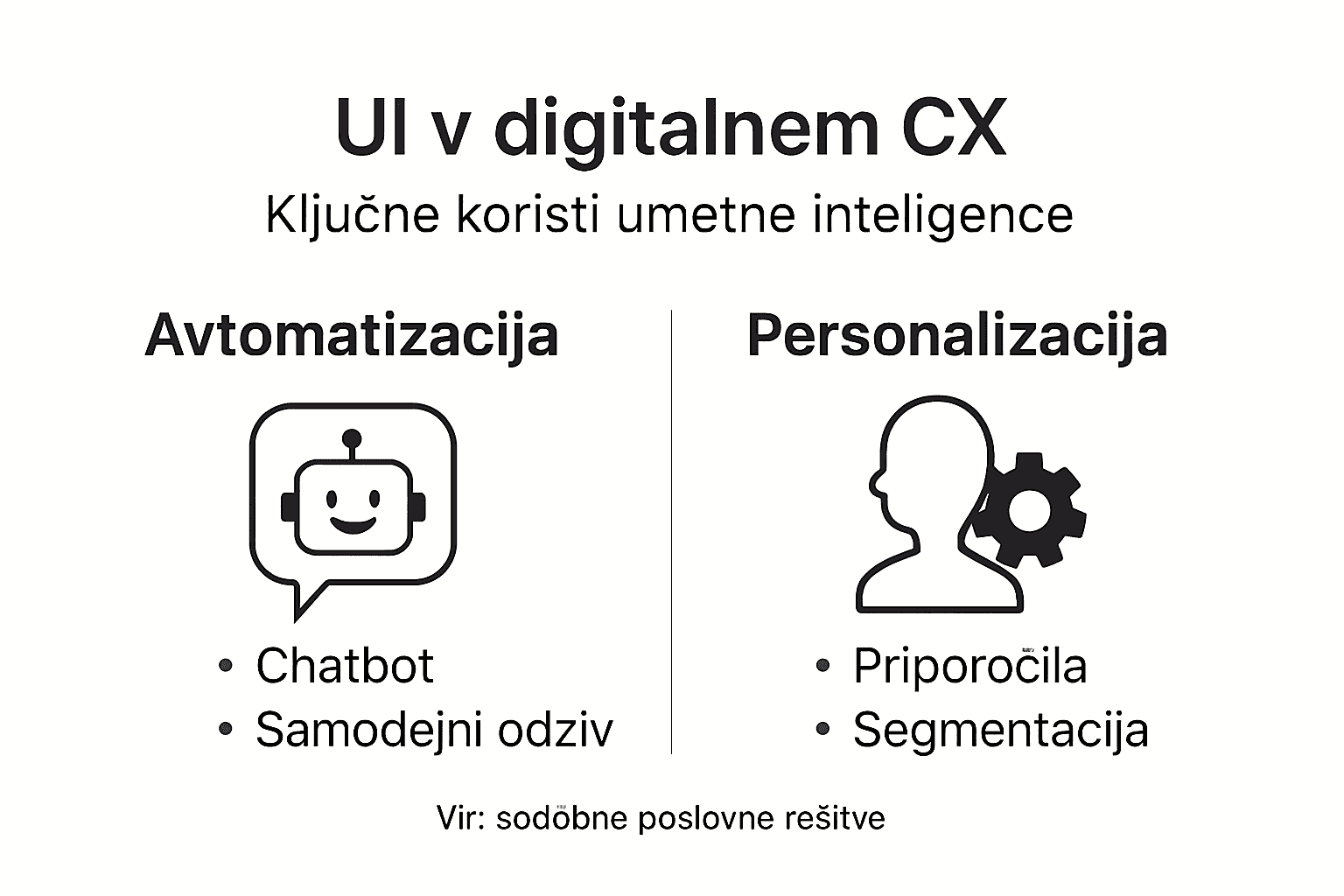
Automation and optimisation
AI automates tasks that would otherwise take an hour. Chatbots answer common questions 24/7 while your staff focus on more complex problems.
Process automation cuts waiting times and improves responsiveness. The customer gets an answer straight away, not three hours later.
Personalisation at a new level
AI analyses each customer's behaviour. What they looked at, where they clicked, what they bought, what they skipped.
Based on that:
It recommends products they really need
It adjusts the price or the offer
The next contact comes at the right time
The message is aimed at them alone
This isn't creepy. It works, and customers appreciate it.
Pattern recognition
AI sees things in data that people never would. Millions of data points, connected in minutes.
You can work out which users are likely to leave, which are ready for an upgrade and which are having trouble with your app.
AI sees what is coming. People usually notice only once it has happened.
Smart content in real time
AI creates and adapts content in real time. If a customer is choosing between two products, AI suggests a review or a comparison at exactly that second.
It happens in milliseconds. The customer never sees it; everything just feels “natural”.
Education and acceptance
Don't forget one key factor: customers need to understand AI. Educating users about artificial intelligence builds trust and acceptance.
When customers know it is AI that is helping them, and not some “strange” technology, they are more willing to accept it.
The link between AI and CX
AI is the tool. CX is the result. Without a clear CX strategy, AI is just unnecessary complexity.
A digital strategy has to be the foundation you build AI solutions on.
Expert tip Start with one specific AI solution: a chatbot, a recommendation system or risk analysis. Measure its effect on your CX metrics, then scale once you see results.
Examples of successful digital CX strategies
Theory is nice, but practice is different. So what does this look like in the real world? The companies that have succeeded share a few traits, and you can learn from them.
A customer-centred approach
The most successful companies don't start with technology. They start with a question: what does the customer really want?
DBS Bank is a well-known example from banking. Their approach was simple: they mapped every touchpoint in the customer journey and asked where it hurts.
A complete understanding of the customer journey is the foundation of every successful CX strategy. It is about integrating the whole experience, not about isolated improvements.
A multichannel approach
A customer may be on the phone, then on your website, then in a physical branch. All three have to connect without a hitch.
Successful strategies include:
A single set of customer data across all channels
The same branding and tone of voice everywhere
Fast help whatever the channel
Memory of context: the customer never has to repeat themselves
Data, data, data
Don't assume. Ask. Find the facts. Using qualitative research to understand the needs of customers is essential.
Digital diaries, video interviews, behavioural analysis: this is gold. This is where you find out what customers really feel, not what they think they ought to feel.
Finding the pain points
Every customer has a point where they get frustrated. In e-commerce it may be delivery. For a bank it is how fast an account can be opened. For a software company it is setup.
When you identify those points and fix them, something remarkable happens. Loyalty jumps.
Your customer's pain is your biggest opportunity for competitive advantage.
Adaptability and staying power
Successful CX strategies are not static. They change as customer needs and market conditions change.
Companies that succeed over the long term measure results regularly and adjust their approach. They are flexible, not rigid.
Results that count
When you get all of this right, the results show. Stronger loyalty. More repeat purchases. More referrals. Lower support costs, because customers understand how things work.
Or, put simply: the customer comes back and recommends you to others.
Key strategies for growth are built on this foundation.
Expert tip Pick the one point in the customer journey that causes the most frustration and improve it. Measure satisfaction before and after the change. That will teach you what works in your context.
The most common mistakes in digital CX transformation
Most companies know they have to change. But do they also know how? This is where things often get complicated. Knowing the mistakes is the first step to avoiding them.
Following technology blindly
Mistake number one: buying impressive technology because the competition has it.
That is the wrong approach. Technology is only a tool. The real goal is to solve the customer's problem. If the technology doesn't do that, you don't need it.
A poor understanding of digital transformation leads companies to invest in systems nobody needs.
Thinking it is a one-off
Digital transformation is not a destination. It is a process that never ends.
Companies that think “we do this once and we're done” soon find themselves out of step. Customers change. Technology changes. The competition changes.
Digital transformation is a marathon, not a 100-metre sprint.
Too little time for planning
Haste is a big problem. People want to see results fast, so they jump into delivery without a clear plan.
Rushed implementation without clear strategic goals is a recipe for failure. It is better to wait a month and have a good plan than to start straight away with a bad one.
Ignoring employees
Your people are not an obstacle. They are the key.
When you change systems without involving them:
They feel threatened
They don't understand why the changes are happening
They have no motivation to help
They stick to old habits
The result? The transformation fails.
Misjudging the impact
You don't understand well enough how digitalisation affects your business model.
You may think online sales will solve everything. But what happens to logistics? To after-sales service? To finance? Everything has to change together.
Unclear strategic goals
Everyone talks about transformation, but what does it actually mean?
The companies with the clearest direction have concrete goals:
Cut waiting time to 24 hours
Increase repeat purchases by 30% within a year
Cut support costs by 25%
Without goals like these, all you know is that you are moving.
The culture doesn't change
A system can change overnight. People and the way they think change more slowly.
Successful transformation requires continuous adjustment and a change in organisational culture. That is harder than buying new technology, but nothing works without it.
Expert tip Before any transformation, I suggest you carry out a clear review: where you actually stand, what the customer wants and what will change in the organisation. Then go through it together with your staff and agree on the stages.
Improve your customers' digital experience with the right strategy
This article has shown why customer experience (CX) is key to your company's success in the digital environment, above all because it connects technology with how customers really feel. Common pain points such as complicated navigation, a lack of personalisation and poorly integrated systems cause dissatisfaction and cost you loyalty. To overcome these challenges, start by measuring where you stand now and with a plan that ties all the key elements of CX to advanced artificial intelligence solutions.
Don't let the complexity of digital solutions hold back your business potential. At CNJ Digital we offer end-to-end strategies that include UX/UI design and the development of AI-informed systems. Our specialists help you define your digital strategy before development begins, so your digital projects are effective and focused on results. Find out how we can help you simplify your customers' journey from first contact to loyalty, and become a leader in your industry.
Start building a memorable experience for your customers now, and make your company more competitive with our help at CNJ Digital.
Frequently asked questions
What does CX mean in the digital environment?
CX (customer experience) covers the customer's whole journey with your company in the digital world, including every interaction and feeling they have while using your services.
How is CX measured?
CX is measured with a range of indicators, such as Net Promoter Score (NPS), customer satisfaction, retention rate and conversion rate. Together they show how well your services are performing.
Why is CX important for companies?
CX is key for companies because it affects customer loyalty, whether customers recommend the company to others, and the company's long-term profitability and success.
How can I improve CX in my company?
To improve CX, measure where you stand now, understand what customers need, optimise the user experience and use data to personalise your services.
Recommended
We write about it. We also build it.
Let's talk about your project
A 30-minute call to understand what you're building and how cvan we help. No brief required.
Prefer email?
info@cnj.si