What is design thinking: the power of innovative solutions
Digital transformation is changing business fast, and as a project manager you face the same question every day: how to create solutions that users will actually adopt. This is where design thinking stands out, a human-centred approach that focuses on understanding and addressing real needs, not only on product development. In this article you will find out how the iterative, practical design thinking process can help Slovenian technology companies implement change successfully.
Table of contents
Core concepts and purpose of design thinking
Key phases and process of design thinking
Examples of use in digital transformation
Benefits, limitations and common mistakes
Comparison with other innovation methods
Key takeaways
Point | Details |
|---|---|
User focus | Design thinking puts users' actual needs at the centre of the process, which leads to better solutions. |
Iterative process | The design thinking process is flexible, so you learn quickly and improve solutions based on feedback. |
Collaboration and experimentation | Diverse teams work together to generate ideas and test prototypes quickly, which encourages innovation. |
Clear problem definition | Pinpointing the actual problem is essential and leads to more successful solutions. |
Core concepts and purpose of design thinking
Design thinking is a human-centred approach to problem solving that puts users at the heart of decision-making. It is a way of thinking rather than a rigid method, and it encourages innovative ways of tackling the challenges in your company.
It is an iterative process that runs in cycles of learning and improvement, not in a straight line. First you understand users' needs, then you ask questions, generate ideas and test them in practice.
What is design thinking, really?
Design thinking is an iterative process built on empathy and an understanding of user behaviour. It focuses on the challenges your customers actually have, not the ones you imagine they have.
The key features of design thinking are:
Experimentation: constantly testing ideas
Prototypes: quickly building models to check solutions
Collaboration: teams with different expertise working together
Optimism: believing that a better solution exists
Learning from mistakes: failure is data, not defeat
How is it different from the traditional approach?
The traditional approach says: “Let's define the problem, then develop a solution.” Design thinking says: “Let's listen to users, understand their pain points, then look for solutions together.”
The difference is fundamental. The traditional approach leads to products nobody wants. Design thinking leads to real solutions that meet users' needs.
For project managers, this means:
Finding out faster what customers actually want
Lower development costs
A better chance of success after launch
Better communication between teams
The goal of design thinking
Creativity for its own sake is not the goal. The goal is to create solutions that work. In technology companies, that means products and services people actually use and love.
When you take up design thinking as a project manager, you get:
A clearer picture of what the user actually needs
Less risk in development
Faster iteration and learning
Better team cohesion and a shared understanding of the goal
Design thinking solves the real problem, not the one you think exists.
Practical tip Before you start development, talk to at least five users. Their responses will guide you more effectively than any brainstorming session.
Key phases and process of design thinking
Design thinking runs in five key phases. They form a flexible cycle, not a set of rigid steps. Project managers can move back and forth between phases depending on what they learn. That is its main advantage over linear approaches.

The process is iterative and adaptable. Each phase of learning brings you closer to the right solution, the one users really need.
Phase one: Empathy
Empathy means focusing on understanding users and their actual needs. These are findings from research and observation, not hypotheses.
In this phase you:
Interview users and customers
Observe how they use existing solutions
Listen to what frustrates them
Identify their pain points and challenges
For project managers this is critical: without a real understanding of the user, you are wasting your time.
Phase two: Defining the problem
Based on what you learned in phase one, you clearly define the actual problem, not the assumed one.
The problem should not be defined as “I need an app” but as “Users lose 30 minutes a day entering data by hand.”
A clear problem definition leads to better ideas and lower development costs.
Phase three: Ideation
Ideation is generating creative solutions without judging them. In this phase, every idea is a good idea.
The group proposes different approaches. Diversity in the team is essential here:
Engineers see the technical possibilities
Designers see the user experience
Product managers see the business impact
Customers see the practical needs
Phase four: Prototypes
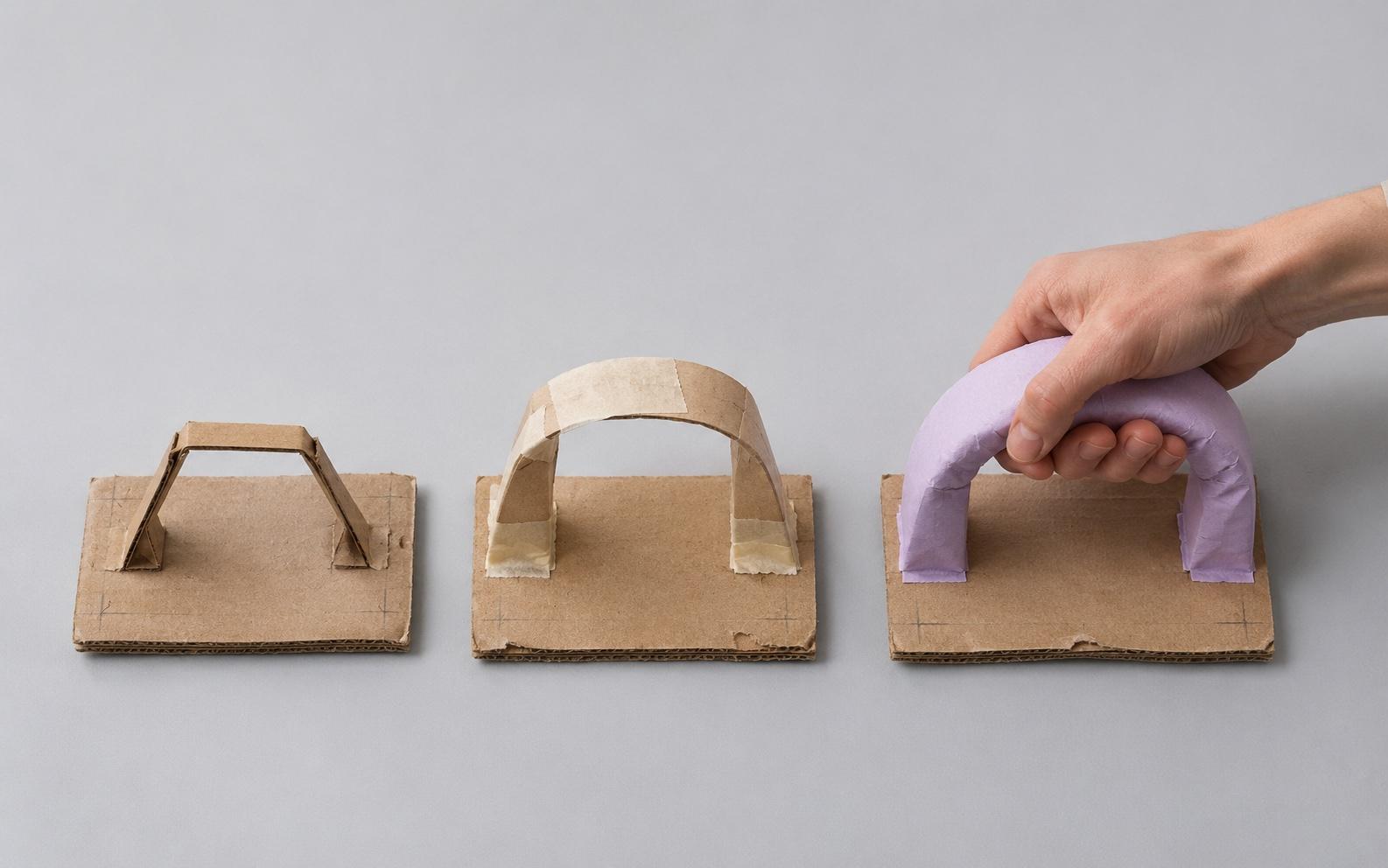
Prototypes are tangible models of ideas that let you test quickly. They are experimental models, not fully developed products.
Prototypes can be:
Paper sketches
Digital wireframes
Basic functionality
Scenario simulations
The goal is to find out quickly what doesn't work before you put millions into development.
Phase five: Testing
In this phase you gather user feedback on the prototype. What you learn with them takes you forward, back or in a new direction.
Testing is not the end of the process. The results often send you back to earlier phases.
A real design thinking process is a spiral of learning, not a straight line, and each loop brings you closer to a better solution.
How the phases work together
The five stages of the design thinking process can be repeated. After testing, you often go back to ideation or even to empathy.
For project managers, this means:
For a condensed view of the design thinking phases and their key activities, see below:
Phase | Main activity | Key outcome |
|---|---|---|
Empathy | Observation and interviews | In-depth understanding of the user |
Definition | Framing the problem | A clear, measurable starting point |
Ideation | Generating solutions | A wide range of usable ideas |
Prototyping | Building models quickly | Checking feasibility |
Testing | Feedback | Further improvements or changes |
Regular feedback from users
Willingness to change the approach
Teamwork across departments
Fast iteration instead of lengthy planning
Practical tip Document every phase: what you learned, what you tested, what changed. Use these notes in the next iteration so you don't repeat the same work.
Examples of use in digital transformation
Design thinking is not a theoretical exercise. In digital transformation it is a practical approach that solves concrete challenges and speeds up the adoption of new technologies. Project managers in Slovenian technology companies use it to implement change faster.
Design thinking improves digital transformation by tying user-centred innovation into organisational change. That is the opposite of the traditional approach, which pushes change from the top down.
Digitalising business processes
When a company digitalises its processes, it faces one big question: what do employees and customers really need?
Design thinking's answer: don't assume. Ask them. Observe how they work now.
Example: should the company build a new project management app?
First you listen to what the project managers tell you
You see how they currently work
You discover that it is documentation they run out of time for, not meetings
You design the new solution around that fact
The result: an app people really use.
Improving the user experience
User experience is the core of digital transformation. Companies often focus on technology, not on people.

Design thinking reverses that relationship.
Users want:
Simplicity, not complexity
Speed, not spinning wheels
Meaning, not confusion
Trust, not secrecy
When you listen to users and test solutions iteratively, you get a product that actually satisfies them.
Internationalisation and adapting to local markets
When a company expands into new markets, it could simply copy its solution. That doesn't work.
Design thinking requires you to understand local contexts and needs. What works in Slovenia may not work in Germany or elsewhere.
Empathy is key. Understanding local differences, habits and expectations leads you to better decisions.
Inclusive digital learning processes
Combining design thinking with technology encourages innovation in digital environments. This matters especially in education and skills development.
When you design digital learning programmes:
You understand how learners actually learn
You test different approaches
You adapt to feedback
You improve iteratively
The result: programmes that actually develop the skills the market needs.
Changes in organisational culture
Technology is only part of the change. The bigger challenge is culture.
Design thinking helps here. By involving employees in the process (empathy, ideation, testing), you make them partners in the change, not its victims.
That reduces resistance and speeds up adoption.
Design thinking in digital transformation is about the people who use the technology, not the technology itself.
Practical tip On your next digital project, start with field research: talk to at least seven users before you write the first line of code. It will cost you a few hours, but it will save you weeks of development and hundreds of euros.
Benefits, limitations and common mistakes
Design thinking has great potential, but it is no magic wand. Understanding its benefits, limitations and common mistakes helps you use it properly and avoid disappointment.
Benefits of design thinking
Design thinking is a user-centred approach that puts actual needs at the centre. That is its biggest advantage.
The main benefits for project managers are:
A better understanding of real problems
Lower development costs
Faster iteration and learning
A higher chance of market adoption
More innovation and creativity
Lower investment risk
When you work with design thinking, you build solutions people actually use. That is the difference between 10% adoption and 80% adoption.
Limitations you need to know
Design thinking demands considerable time and flexibility. It is not a quick method. The real benefits come after months, not days.
Limitations:
It takes more time to prepare
Teams have to be truly open to change
Cognitive biases can creep in
It is complex to integrate into traditional systems
It requires real diversity in the team
For project managers this means: choose the right projects. Don't use design thinking for routine work. Use it for challenges where you really need innovation.
Common mistakes teams make
Common problems include skipping thorough empathy research, jumping to solutions too soon and not testing enough.
Mistakes to avoid:
Assuming what users need instead of asking them
Rushing to a solution before defining the problem
Not testing enough with real users
Too little diversity in the team
Ignoring feedback and denying the consequences
Superficial application: the name without the process
Make these mistakes and you end up with expensive products nobody wants.
How to avoid these mistakes
First: don't assume. Ask the right people and observe them.
Second: hold off on development. Define the problem, generate ideas and test prototypes before the first line of code.
Third: be open to learning. When testing shows you were wrong, be glad. That is data, not defeat.
Fourth: bring in diverse perspectives. Uniform teams produce uniform solutions.
The biggest mistake is jumping straight into development. Design thinking saves you millions because you can be confident you are making the right decisions.
Practical tip Whatever project you take on, always set aside at least 20% of the time for empathy and 15% for testing. It won't speed the project up, but it will make it more successful and reduce the risk of failure.
Comparison with other innovation methods
Design thinking is not the only method for innovation. It competes with agile development, lean startup, Six Sigma and other approaches. The question is: which is best for your project?
The answer: it depends on what you are building.
How it differs from traditional methods
Traditional approaches focused on analysis and linear logic. Define the problem, draw up a strategic plan, then execute.
Design thinking puts creativity and empathy at its heart. It is about understanding people, not about piling up data.
The difference is fundamental:
Traditional approach: analysis, structure, predictability
Design thinking: creativity, testing, learning
Traditional approach: top down
Design thinking: from the users up
Comparison with Lean Startup
Lean startup is a method that cuts development time and cost. You build a little, test faster, learn.
It is similar to design thinking, but with a different focus.
Design thinking tells you: understand users, then test. Lean startup says: test fast, even without full understanding.
For project managers: design thinking is better when you care about what actually works for users. Lean startup is better when you care about how fast you can get to your first revenue.
Comparison with Agile development
Agile is a project management method that emphasises iteration and flexibility. Sprints, feedback, fast adaptation.
Design thinking is an approach to the problem. Agile is an approach to the process.
In fact, you can combine the two. Design thinking helps you define the right problem, agile helps you build the solution quickly.
To make the differences between the approaches clearer, here is a comparison table:
Approach | Main emphasis | Typical goals | Biggest advantage |
|---|---|---|---|
Design thinking | Empathy and experimentation | Finding real needs | User-driven innovation |
Lean Startup | Fast market testing | Validating a business idea | Lower launch costs |
Agile | Iterative development | Fast delivery of solutions | Adaptable processes |
Six Sigma | Analysis of defects and data | Optimising existing processes | Precision and fewer defects |
Comparison with Six Sigma and other analytical methods
Six Sigma focuses on data, measurement and reducing defects. It is excellent for improvements, poor for innovation.
Design thinking, by contrast, encourages experimentation and pushing boundaries. It is about discovering new possibilities, not about control.
For a new project, you don't need Six Sigma. You need design thinking.
Comparison with other creative methods
Design thinking differs from other innovation approaches in that it is systematic. It is more than brainstorming and daydreaming.
It has five clear phases. It has structure. It has learning.
So is it better than brainstorming? Yes. Brainstorming is one phase (ideation). Design thinking is the whole process.
Which approach to choose
It depends on your question:
What are we building? → Design thinking
How do we build fast? → Agile
How do we build cheaply? → Lean startup
How do we improve what exists? → Six Sigma
How do we generate ideas fast? → Brainstorming + design thinking
A combination works best. Use design thinking to understand the problem, agile to build, lean to test the market.
Practical tip For your next project, combine design thinking (the first month for empathy and definition) with agile development (the following months for building). That gives you the best result: the right solution, delivered fast.
Put the power of design thinking to work with a digital partner
Design thinking is the key to real, user-friendly innovation that comes from a deep understanding of user needs and from iterative improvement. If you are a project manager or a company that wants a successful digital transformation with less risk and lower cost, the right place to start is a focus on empathy research and prototype testing. These are the points where many teams fall down, which leads to expensive projects with no real value for users.
With https://cnj.si you gain a trusted partner who helps you define the problem clearly, shape sensible strategies and build AI-informed digital solutions that come out of in-depth analysis of user behaviour and iterative testing. Our team combines strategic consulting, UX design and advanced technology, so you don't waste valuable resources on the wrong ideas. See how we can work together to make your innovation projects more successful and your next step safe and effective.
Start today with comprehensive digital strategies at CNJ and turn your challenges into opportunities with the help of proven design thinking.
Frequently asked questions
What is design thinking?
Design thinking is a user-centred approach to problem solving built on empathy and an understanding of user needs. It is an iterative process with phases for empathy, problem definition, ideation, prototyping and testing.
How does design thinking differ from traditional approaches?
Design thinking focuses on understanding user needs before a solution is developed, whereas traditional approaches call for defining the problem first and then looking for a solution. That difference often leads to more relevant, more user-friendly solutions.
What are the key phases of the design thinking process?
The design thinking process has five key phases: empathy (understanding users), problem definition (clearly framing the real problems), ideation (generating solutions), prototyping (building models quickly) and testing (gathering user feedback).
How does design thinking contribute to innovation?
Design thinking encourages innovation by focusing on user needs, experimentation and learning from mistakes. It lets companies develop solutions users actually need, instead of an outpouring of ideas that may not meet real needs.
Recommended
We write about it. We also build it.
Let's talk about your project
A 30-minute call to understand what you're building and how cvan we help. No brief required.
Prefer email?
info@cnj.si