A URL shortener for marketing teams and agencies: what it has to do
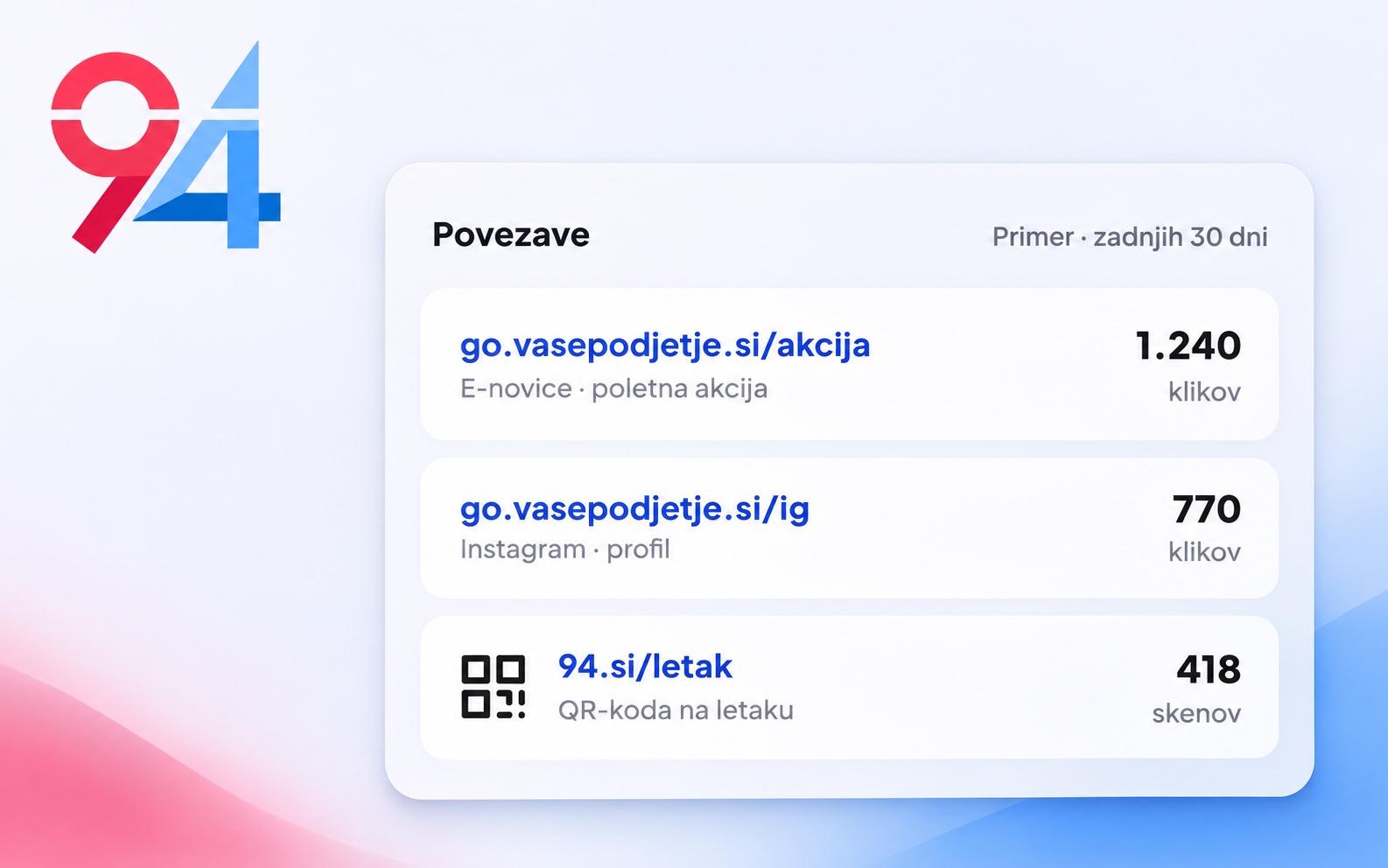
A short link is part of the message, not a technical detail. It decides whether the recipient trusts it, whether you can measure a single channel, and whether a printed QR code still leads to the right page six months later. A marketing team or an agency therefore needs four things from a URL shortener: its own domain, measurement by channel, a destination that can be changed after publishing, and clear ownership of the links.
A disclosure first: 94.si is our product. We have built and run it at CNJ since 2016, and teams at A1, Argeta and Equa manage their links with it. So this article is not a neutral comparison of providers. It gives you the criteria we would use to judge any URL shortener, and shows how 94.si meets them.
In short
Trust. A link on your own domain, such as go.yourcompany.com/offer, tells the recipient who is writing. In 94.si, connecting one custom domain is included in the free plan.
Print. You print the QR code once and change the destination behind it whenever the page changes.
Measurement. Each channel gets its own link and its own UTM parameters, so you can see where the clicks came from.
Ownership. Links, domains and collaborators are organised in projects, so handing work over to a client or a new agency does not mean reprinting.
Data. The service is run by a Slovenian company, the data is on servers in the EU, and a click sets no cookies.
Price. The paid plan starts at €3.99 a month, which is less than Bitly, where the cheapest paid plan costs USD 10 a month.
People do not trust a link that does not say who sent it
A short link hides its destination. That is exactly why scammers like it, and exactly why recipients are careful.
In a SimpleTexting survey of more than 1,400 Gen Z and Millennial Americans, 59% said they rarely or never click links in texts from brands. In a TextMagic survey of 1,800 US consumers from March 2025, 49% named a suspicious link as a red flag and 47% an unknown sender.
Both surveys are American, so the figures should not be carried over literally. The direction is confirmed by local data. Slovenia's national response centre SI-CERT handled 216 cases of fraud by SMS and messaging apps in 2023, almost five times as many as the year before. In the same year the Slovenian police recorded €3.5 million in damage from fake messages in online banking.
For marketing this means one simple thing: an unfamiliar short link is no longer neutral. A link in which the recipient recognises your name has an advantage before it is even opened.
When choosing a URL shortener, check two things:
Whether you can use your own domain. In 94.si you connect your own domain or subdomain. One domain is included in the free plan, and the business plan supports up to ten.
How the provider prevents abuse. If scammers abuse a shared domain, security filters block it for everyone. 94.si checks every new destination with Google's Web Risk service, rejects links that point directly to Windows programs, and checks every day that its domains are not on any blocklist.
You cannot fix what is printed, but you can change where the link goes
A static QR code has the web address written into it. Once printed, it cannot be changed. A dynamic QR code goes through a short link, so you change the destination in your account and the printed code stays the same.
The difference shows when a price list changes, a campaign ends or a website moves. That is when it matters whether your leaflets, packaging and posters still work or whether you are ordering a reprint.
Three 94.si features matter here in practice:
Changing the destination after printing. You download the code as SVG for print or PNG for the web, and change the destination at any time.
An end date with a fallback page. You give the link an end date. Anyone who clicks after the campaign is over lands on a current offer, not on an error page.
Destination monitoring. On the business plan, 94.si checks every destination each night and warns you when one stops working. You find out before your customers do.
QR codes are also becoming mandatory. Since 10 October 2025, Regulation (EU) 2024/900 requires a transparency notice for political advertising, and a QR code can lead to it. Retail is preparing to move from barcodes to QR codes, which we cover in QR codes instead of barcodes. The same applies in both cases: you print the code once, and the content behind it changes.
Measure by channel, not by guesswork
If you use the same link in a newsletter, on Instagram and on a leaflet, you get one number that says nothing about the channels. The fix is old and simple: each channel gets its own link, even though they all lead to the same page.
In 94.si this means:
Separate links. For each one you see clicks by day, country and device. You can exclude your own test clicks.
UTM parameters without typing. UTM parameters are additions to a web address that let Google Analytics recognise the source of a visit. You enter the source, medium and campaign name in fields, and 94.si attaches them to the destination on redirect. The short link stays short.
A/B testing the landing page. You split the traffic of one link between two pages and compare the response.
One link, several directions. iPhone users go to the App Store, Android users to Google Play, and a customer from Austria to the German page.
Advertising pixels. On the business plan, a Meta, Google Ads or LinkedIn pixel fires before the redirect, but only on links on your own domain. A pixel can set cookies, so informing visitors is your responsibility.
One limit applies to every URL shortener: a click is not a purchase. A shortener measures how many people opened the link. Whether they sent an enquiry or bought something is measured by the analytics of the landing page. The channel with the most clicks is often not the channel with the most enquiries, so you need both measurements.
What changes when an agency manages the links
An agency does not manage its own links. It manages its clients' links. The problems do not show in the first campaign. They show when the cooperation ends.
The most common mistake is that a client's links and QR codes live in one employee's personal account or on the agency's domain. When the employee leaves or the client changes agencies, the codes on packaging and printed material have to be replaced, or everyone depends on goodwill.
So settle three things before the first code is printed:
The domain should be the client's. Short links should run on the client's domain, which the client also renews. The agency gets access, not ownership.
One project per client. In 94.si a project groups links, domains and collaborators. The business plan includes up to 30 users and an audit trail of changes, so it is clear who changed a destination and when.
Data roles should be written down. For click data, the organisation that uses the links is the controller and 94.si is the processor. On request we sign a data processing agreement under Article 28 of the GDPR.
For clients in the public sector and regulated industries, it also matters where the data is. 94.si is run by CNJ d.o.o. from Ljubljana, and the data is on servers in the European Union. A click sets no cookies, the link owner sees only aggregated statistics, and the full IP address is kept for no more than 30 days.
Agencies will also find password-protected links useful, for example for a preview that only the client may open, as well as an API and an MCP connection for automation, both available as paid add-ons.
What it costs
Prices are valid in November 2026 and exclude VAT.
Free, €0. 20 links, 20 QR codes, 10,000 clicks and one custom domain. You create an account with your email address, with no password and no card.
Pro, €3.99 a month. 250 links, 150 QR codes, 100,000 clicks, up to five custom domains and a link ending of your choice, such as 94.si/catalogue.
Business Pro, €129.99 a month with annual billing. Unlimited links, QR codes and clicks, up to 30 users, up to ten custom domains, pixels, destination monitoring and an audit trail. The first 50 subscribers pay €97.49 a month for as long as they stay subscribed.
For comparison: Bitly charges USD 10 a month for its cheapest paid plan, Core, with annual billing only, and includes a custom domain only from the Growth plan at USD 29 a month. In 94.si a custom domain is already part of the free plan, and the paid plan starts at €3.99 a month. The plans are not counted the same way: Bitly limits the number of new links per month, while 94.si limits the total number of links in the account. The comparison is based on the public price lists in November 2026.
With the personal plans, check one more detail. When the included clicks are used up, links keep working, but visitors see a 94.si notice for a few seconds before the redirect. For a campaign with a large reach, the right plan is therefore the one with unlimited clicks.
How to start
The quickest test is free: create a link, change its destination and open the original short address. In five minutes you know whether the tool fits the way you work. Create a free account at 94.si.
If a team manages the links, or you manage them for clients, write to info@cnj.si and we will prepare an offer. If you need 94.si connected to your system, or a custom digital product, get in touch. The other products we build ourselves are listed under internal projects.
Frequently asked questions
What is a URL shortener?
A URL shortener turns a long web address into a short link that redirects the visitor to the chosen page. A business URL shortener also measures clicks, supports your own domain and lets you change the destination later.
Can I change the destination of a QR code after printing?
Yes, if the code is dynamic, meaning it goes through a short link. In 94.si you change the destination page in your account and the printed code stays the same.
Can an agency manage several clients' links in one account?
Yes, on the business plan. Each client gets a project with its own links, domains and collaborators. The plan includes up to 30 users and up to ten custom domains.
How do I find out which channel brings more clicks?
Create a separate short link for each channel, even if they all lead to the same page. Then compare clicks over the same period. To compare enquiries or purchases, add UTM parameters and use your website analytics.
Is 94.si GDPR compliant?
Yes. The service is run by CNJ d.o.o. from Ljubljana under Slovenian law and the GDPR. The data is on servers in the EU, a click sets no cookies, and the link owner sees only aggregated statistics. On request we sign a data processing agreement with companies.
Is 94.si an alternative to Bitly?
Yes, and it costs less. The paid 94.si plan is €3.99 a month, while the cheapest paid Bitly plan is USD 10 a month with annual billing. 94.si includes a custom domain in the free plan, Bitly from the plan at USD 29 a month. Other differences are support in Slovenian, data processing in the EU and passwordless sign-in.
We write about it. We also build it.
Let's talk about your project
A 30-minute call to understand what you're building and how cvan we help. No brief required.
Prefer email?
info@cnj.si